SoEasy Tile: Puzzle Match
- 4.9
- Rating
- 500.00K
- Installs
- Free
- Price
 Analysis by App-foxy
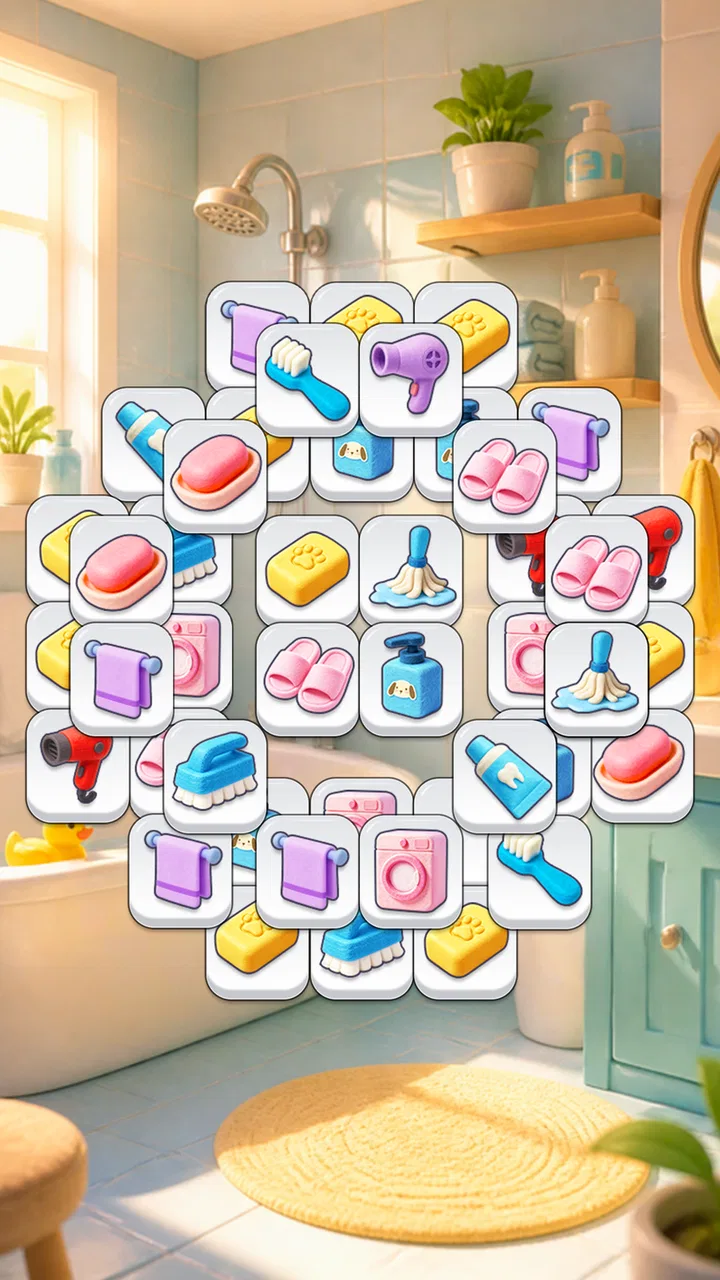
I approached SoEasy Tile: Puzzle Match as the kind of casual game I could open for a few quiet minutes, rather than something demanding a full evening of concentration. Its core idea is easy to understand: arrange glossy three-dimensional tiles, find matching groups, and clear them through triple-match play. That simplicity is the main attraction, but it also means the quality of each session depends on how carefully I read the board instead of blindly tapping the most obvious pieces.
Developed by SOFISH GAMES, this free game sits comfortably in the casual puzzle space. It is rated for Everyone, works on devices running Android 6.0 or later, and the current version is 1.0.8. The store page shows a 4.9 average from around 1.5 thousand ratings, while its install count has passed 500 thousand. Those figures suggest that the game has found an audience, but they do not replace the more important question: does the simple matching loop stay enjoyable after the first few rounds?
How I play it when I want a short, focused break
I use these short sessions to see how well the puzzle fits around real interruptions, not just when I can give it my full attention. A quick scan before each move helps me leave the board in a state I can understand when I return, rather than making rushed taps I later regret. That same habit makes it easier to judge whether the game’s visual and touch demands suit different players and settings.
You May Also Like

 AccuWeather: Weather Radar
AccuWeather Review: A Quick, Clear Forecast for Everyday Decisions
For everyday plans, the best forecast is the one you can understand quickly. AccuWeather makes rain timing, radar, and local conditions easy to act on, with a few trade-offs.

 Hill Climb Racing
Why Hill Climb Racing Still Turns Crashes Into One More Run
A tiny car, a bumpy hill and one more upgrade: Hill Climb Racing keeps resurfacing because its simple chaos makes every near-miss feel personal.

 AliExpress - Shopping App
AliExpress Makes Global Shopping Feel Personal, but Shoppers Bear the Risk
AliExpress turns a global marketplace into a pocket-sized discovery engine. Its reach is useful, its shopping loop compelling, and its trade-offs easy to miss.

 Lords Mobile: Kingdom Wars
Lords Mobile Is a Kingdom-Building Routine, Not a Quick Match
A case-by-case verdict on the building, battles, device demands, and social commitments that make Lords Mobile rewarding for some players and exhausting for others.

 PDF Scanner app - TapScanner
TapScanner Makes Paperwork Easier to Capture, Check, and Share
TapScanner makes scanning with a phone feel less like a rescue operation and more like a dependable step in getting work done. Its capture tools are useful, though not flawless.

 Block Blast!
 Shows How Much a Puzzle Game Can Leave Out
A quiet grid game shows why puzzle players increasingly value instant clarity, repeatable skill and low-pressure play—and where the genre still needs to catch up.
More From Our News Desk
View All News


The basic board routine
My most reliable starting habit is to pause before touching anything. In a three-dimensional tile puzzle, the first visible match is not always the best move. A tile that looks convenient may be covering another piece, blocking a useful group, or filling one of the limited spaces available for temporary storage. I scan the whole arrangement, identify exposed groups, and then choose a move that opens the board rather than merely removing something quickly.
This makes the game feel more thoughtful than a simple tap-to-match activity. The glossy presentation draws attention to individual pieces, but the real challenge is managing what becomes visible next. I try to keep the lower area of the board readable and avoid creating a messy row of unmatched tiles. When several groups are available, I usually select the one that exposes the most new surface or reduces congestion.
A practical everyday scenario is a short wait at a bus stop or a few minutes before an appointment. I can begin a round without learning a complicated control scheme, make a handful of deliberate moves, and stop when my attention is needed elsewhere. That makes it more convenient than a longer strategy game, especially when I want mental activity without a story, multiplayer pressure, or a large commitment.
Why the first few moves matter
Early moves establish the shape of the rest of a round. If I remove tiles only because they form an immediate triple, I can leave behind awkward singles that are difficult to combine later. I get better results by treating each move as a small planning decision: which pieces will remain available, which ones will be buried, and how much room will be left for temporary tiles?
One useful technique is to delay a match when it would consume the only visible example of a useful type. That sounds counterintuitive, but holding a piece for a moment can preserve flexibility while I uncover more of the board. I do not follow this rule rigidly; if the board is becoming crowded, clearing a safe triple is usually more valuable than waiting for a perfect sequence.
The strongest beginner habit is to value open space as much as completed matches. A clean board gives me options, while a nearly full holding area turns even a small mistake into a forced restart or a lost opportunity. This is the difference between tapping reactively and playing the puzzle with a repeatable method.
Settings and device preparation
Before settling into longer sessions, I check the available in-game settings rather than assuming the default setup is ideal. On a small phone, visual clarity matters more than decorative polish. I make sure the screen is bright enough to distinguish similar tile designs and keep the device at a comfortable angle so that the three-dimensional layout does not become visually confusing.
I also treat sound and notification interruptions as part of the setup. If I am playing in a quiet room, audio can make the experience more pleasant; in a waiting room or shared space, I prefer a quieter configuration. The important point is not to hunt for an elaborate control system, but to remove distractions before starting a focused round.
Because the game is designed for casual play, I would not expect a deep settings menu to transform the experience. Its value comes from the board itself, so users who need extensive accessibility controls, advanced display customization, or highly configurable input options should inspect the version available on their device before relying on it as a primary puzzle tool. For ordinary touch play, however, the basic setup is approachable.
A repeatable session workflow
My preferred workflow has three stages. First, I scan for exposed triples and note which tiles are blocking larger clusters. Second, I clear moves that open the board while keeping the temporary holding area orderly. Third, I slow down whenever the board becomes crowded, because rushed taps are more expensive at that point than they are at the beginning.
This routine also helps when I return after a break. Instead of trying to remember an elaborate strategy, I simply reassess the visible groups and rebuild the board in my head. That is one reason the game works well for short sessions: the mental reset is quick, and I do not need to recall a storyline or a complex set of rules.
Finding faster patterns without playing carelessly
After several rounds, I started noticing that speed comes from recognition rather than frantic tapping. I look for pairs that are already close to a third matching tile, then check whether taking them will expose something more useful. I also watch for repeated tile types near the edges of a cluster, since clearing those can reveal the pieces underneath with less disruption.
Another helpful pattern is to separate “safe” matches from “urgent” matches. A safe match is one I can complete without filling the holding area or hiding a valuable route through the board. An urgent match is one that prevents the board from becoming blocked. Experienced play is often about choosing between these two, not simply searching for the first available triple.
I avoid building a temporary collection around several unrelated tile types. When I do need to hold unmatched pieces, I try to keep the group small and connected to a clear plan. If I cannot explain why a tile is being kept, it is usually a sign that I should reconsider the move rather than continue adding to the pile.
These habits are especially useful for players who normally rely on luck in match games. The game still has moments where the layout determines what is possible, but careful ordering gives me more control. I can often turn a seemingly blocked position into a manageable one by clearing the most obstructive visible piece instead of chasing a distant match.
How it compares with familiar casual alternatives
Compared with a traditional two-dimensional match-three game, this title feels less focused on swapping adjacent pieces and more focused on spatial reading. There is no need to plan a chain reaction in the same way. Instead, I am managing visibility, grouping, and available room. Players who enjoy calm object-matching puzzles may find this more satisfying than a fast combo-based game.
It is also different from word puzzles or number games. Those alternatives test vocabulary or calculation, while this one mainly rewards visual memory and sequencing. I would choose it when I want a low-language activity that I can understand immediately. On the other hand, someone looking for a deep logic system, a strong narrative, or a competitive score chase may find the matching loop too narrow.
The three-dimensional presentation gives it more visual character than a flat tile grid, but it can also make crowded arrangements harder to read. On a larger screen, that depth may feel inviting; on a smaller display, I need to slow down and inspect overlapping pieces. This is a genuine trade-off rather than a flaw that affects everyone equally.
Where the free model fits
The game is free to download, with optional in-app purchases ranging from $0.99 to $64.99 per item. That matters because the basic appeal is easy to sample without paying first, but players should still approach the purchase options deliberately. I would not buy anything simply to rush through a difficult moment. The best reason to spend would be a clear personal decision that the extra help or content improves the way I already enjoy playing.
For families, the Everyone rating makes the game an approachable choice from an age-classification perspective. I would still supervise younger players around any in-app purchase screen, as I would with any free game that offers paid items. Adults who want a no-cost distraction can enjoy the central puzzle without treating the game as a serious financial commitment.
The main limitation of this model is that some players may dislike seeing purchase prompts in a game whose rules are intentionally simple. If you prefer a fully paid puzzle with one upfront transaction and no optional spending, a premium alternative may feel cleaner. If you want to try before deciding, the free entry point is more convenient.
Advanced play and its limits
There is a ceiling to how much strategy this format can provide. My habits improve consistency, but they do not turn the game into a large tactical system with many distinct modes. The central loop remains matching glossy tiles and managing the board. That is ideal for relaxation, yet it may feel repetitive to players who need constant mechanical variety.
I also would not confuse a good run with complete control. A layout can reveal helpful pieces in an inconvenient order, and a careful player may still reach a position that feels constrained. The right response is to treat each board as a fresh arrangement rather than assuming that one memorized sequence will work every time.
For that reason, I recommend short, intentional sessions over marathon play. When I play for too long, the visual similarities between tiles become more tiring, and I make poorer decisions because I stop scanning properly. A brief pause restores attention and usually helps more than tapping faster.
Who should try it, and who should skip it
I think this game is a good fit for people who enjoy visual matching, gentle brain training, and puzzles that can be started without a tutorial-heavy introduction. It is particularly suitable for commuters, casual players, and anyone who likes improving through small habits rather than mastering complicated controls. The low barrier to entry is one of its strongest qualities.
I would be more cautious about recommending it to players who want a rich campaign, direct competition, elaborate character progression, or a constantly changing ruleset. It is also not my first choice for someone who finds layered three-dimensional boards visually tiring. In that case, a flatter puzzle interface may be easier to read and less demanding on the eyes.
Parents and shared-device users should also remember that the Everyone rating describes the content category, not whether every person will find the visuals comfortable or the optional purchases suitable. I would show a younger player how to pause and how to avoid accidental spending before handing over the device.
My final take after settling into the routine
SoEasy Tile: Puzzle Match succeeds because it does not make the player learn much before getting to the satisfying part. The glossy tile design, triple-match structure, and three-dimensional layouts create a pleasant middle ground between pure relaxation and light concentration. I enjoy it most when I use a deliberate scan-clear-reassess rhythm instead of treating every move as an impulse tap.
Its weaknesses are closely tied to its strengths. The focused format is accessible, but it can become repetitive. The depth adds visual interest, but crowded boards may be harder to parse on a small phone. The free price makes trying it easy, while optional purchases mean cautious players should keep an eye on spending decisions.
My recommendation is straightforward: try it if you want a compact casual puzzle with enough board management to reward attention. Keep sessions short, protect open space, and check the settings before playing in a shared or quiet environment. If your ideal game is a deep strategy experience or a completely purchase-free premium puzzle, choose something else. For everyone in between, this is a polished little matching game that turns a simple rule into a surprisingly mindful break.
FAQs for SoEasy Tile: Puzzle Match
01What is the main objective of SoEasy Tile: Puzzle Match?
SoEasy Tile: Puzzle Match is a tile-matching puzzle game where the main objective is to clear the board by matching identical tiles. Players must strategically select tiles in sets of three to remove them from the game board, advancing through progressively challenging levels.
02Is SoEasy Tile: Puzzle Match free to play?
Yes, SoEasy Tile: Puzzle Match is free to download and play. However, the game offers in-app purchases for players who wish to enhance their gaming experience, such as purchasing additional lives or boosters to help overcome difficult levels.
03What are the key features of SoEasy Tile: Puzzle Match?
SoEasy Tile: Puzzle Match boasts a variety of features, including colorful graphics, intuitive controls, and numerous levels with increasing difficulty. It also offers daily challenges and events to keep the gameplay fresh, along with leaderboards to compete with friends and players worldwide.
04Does SoEasy Tile: Puzzle Match require an internet connection to play?
No, SoEasy Tile: Puzzle Match can be played offline. However, an internet connection is required for certain features like accessing leaderboards, participating in events, and making in-app purchases. Playing online also ensures your progress is saved and synchronized across devices.
05Are there any special tips for beginner players in SoEasy Tile: Puzzle Match?
Beginner players should focus on creating combinations that clear multiple tiles at once, maximizing their moves. Pay attention to the tile patterns and plan ahead to avoid getting stuck. Utilize boosters wisely, and don’t forget to take advantage of daily challenges for extra rewards.
Pros
- Intuitive drag-and-drop controls.
- Visually appealing tile designs.
- Regular updates with new levels.
- Quick load times and smooth performance.
- Offline play available for on-the-go fun.
Cons
- Limited free hints available.
- In-app ads can be intrusive.
- No multiplayer mode.
- Occasional repetitive levels.
- Requires frequent internet for updates.

SoEasy Tile: Puzzle Match
Gallery